What challenges do new online learning programs face?
A corporate training team decides to launch its first online course. They have the content, the instructor, and a launch date. What they don’t have is certainty about how many people will actually enroll, how much infrastructure budget to set aside, or who to call if the platform goes down on launch day.
The same scenario plays out at universities running a pilot, edtech startups validating their first product, and nonprofits digitizing a training program for the first time. All of these organizations end up searching for the same answer: what Open edX® hosting makes sense when you don’t yet know how much you’ll grow?
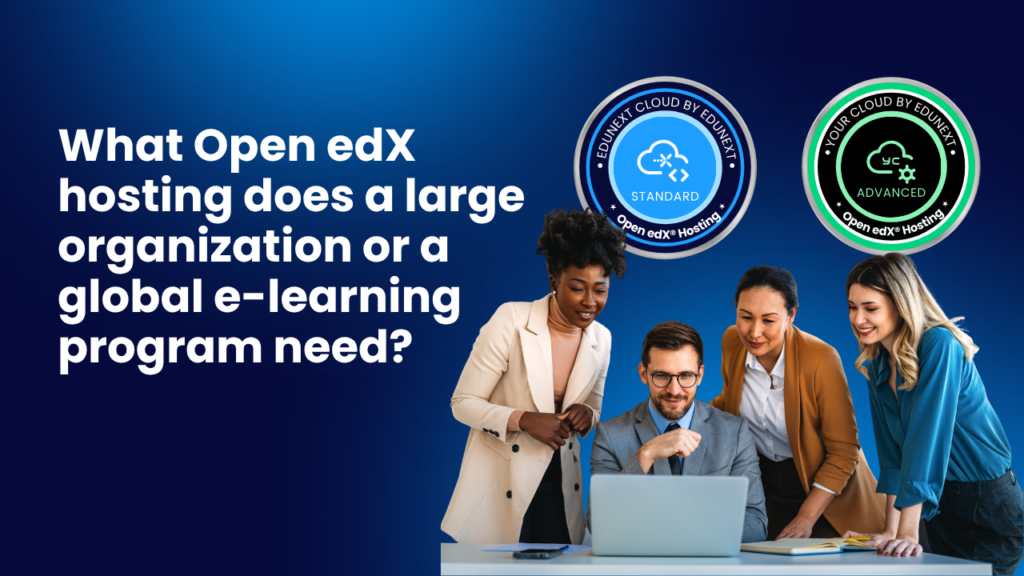
edunext answers that question with two entry-level products, EC Core and YC Essential, both built on the same official Open edX® release but with two different infrastructure models depending on who manages the cloud.
What is the difference between EC Core and YC Essential hosting?
Both products deliver LMS and Studio on the latest official Open edX® release, with the language pack the organization chooses, and access to the same open source enablers: optional EOX and composable theming. The difference between the two isn’t functionality — it’s architecture.
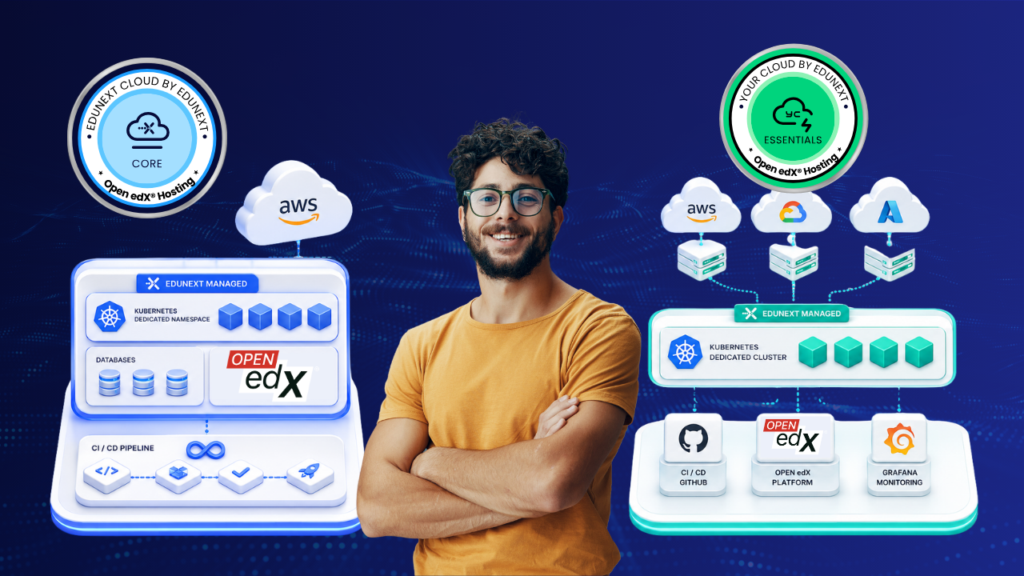
Edunext Cloud Core hosts the platform inside the infrastructure edunext manages in AWS. The organization gets a dedicated, Tutor-compatible Kubernetes namespace, with databases and a CI/CD pipeline already configured. There’s no cloud account to manage or provider to contract separately: infrastructure cost is included in the package.
Your Cloud Essential follows the Bring Your Own Cloud (BYOC) model: the organization brings its own AWS, GCP, or Azure account, and edunext installs and operates a dedicated Kubernetes cluster on top of it, with a CI/CD pipeline via GitHub. This path makes sense when the organization already has a relationship with a cloud provider, needs to comply with internal data governance policies, or prefers to retain direct ownership of compute resources.
How much capacity does each hosting option provide?
In EC Core, edunext manages up to 25 GB of RAM and 20 vCPU, dynamically allocated based on usage. That quota is calibrated to support up to 100 concurrent users for no more than 20% of the time, equivalent to roughly 1,500 monthly active users (MAU). Autoscaling is included within that quota, with no extra compute cost at this tier.
In YC Essential, the ceiling depends on whether the organization contracts directly with its cloud provider, with a reference limit of up to 500 GB of RAM and 400 vCPUs — enough for scenarios with up to 3,000 concurrent users or close to 50,000 MAU. edunext dynamically optimizes resource use, and the organization can monitor actual consumption through the same Grafana dashboards available across the entire product line.
What security and reliability features are included?
No organization wants to find out how solid its hosting is on the day something breaks. EC Core includes a 99.0% availability SLA, with proactive monitoring and service credits for SLA breaches. YC Essential offers a 99.5% SLA, with periodic availability reports.
Both products include encryption in transit (TLS 1.2+), encryption at rest via KMS, and secret management through vault. YC Essential adds optional DDoS protection and a web application firewall through the cloud provider, plus a CDN for static files.
Daily backups are guaranteed in both cases, with 30-day retention and recovery objectives (RTO/RPO) of 24 to 48 hours depending on the product. Staging environments are temporary during upgrades; a permanent environment can be added as an extra service later, once the program needs it.
What support is included when getting started?
Both products include access to the knowledge base and AI-powered responses available 24×7. Priority technical support includes 10 tickets per year in EC Core and 15 in YC Essential, with response times under 48 hours during extended business hours (8×5).
Onboarding includes a pre-recorded training session in EC Core and a one-hour live session in YC Essential. At the end of the relationship, both products guarantee data portability: export of MySQL and MongoDB databases, a copy of the uploads bucket, and access to the Git repository that defines the installation. In YC Essential, the organization also keeps the kubectl configuration file and can continue operating the platform independently using `tutor k8s apply`.
How should I choose between EC Core and YC Essential?
The decision comes down to where the organization wants its infrastructure to live and who covers that direct cost. EC Core is the more straightforward option for teams that want to get started without managing a relationship with a cloud provider, with infrastructure cost included. YC Essential makes sense when the organization already operates within its own cloud environment, needs to keep control of that account for compliance or budget reasons, or projects growth that goes well beyond the range EC Core covers.
Either way, the starting point is the same: a complete Open edX® platform, built on the same architecture and operational practices that edunext applies at any scale, ready to grow alongside the program.

Frequently asked questions
How much does it cost to host Open edX® for a small organization?
Cost varies by model. EC Core includes edunext-managed infrastructure in the package price; YC Essential incurs an additional cost for the cloud provider the organization contracts directly with (AWS, GCP, or Azure).
How many users can the entry-level plan support?
EC Core is calibrated for roughly 1,500 monthly active users. YC Essential can scale up to nearly 50,000 MAU, depending on the resources the organization chooses to provision in its own cloud.
Do I need technical expertise to run EC Core or YC Essential?
No. edunext manages installation, upgrades, and monitoring in both products. YC Essential requires the organization to maintain an active cloud account, but platform operations remain with edunext.
Can I move from YC Essential or EC Core to a higher tier later?
Yes. Both products share the same architectural foundation as the rest of edunext’s hosting line, enabling scaling to EC Growth, EC Standard, or YC Advanced without changing provider or technology.