What Is Open edX® and Why Does Hosting Matter?
Open edX® is one of the leading open source LMS platforms in the world, originally developed by MIT and Harvard and used today by hundreds of universities, corporations, and governments to deliver online learning at scale. Unlike proprietary LMS platforms, Open edX® gives institutions full control over their learning environment: the code, the data, and the experience.
But that flexibility comes with a trade-off. Open edX® requires infrastructure decisions that proprietary platforms handle for you. How you host your instance directly affects performance, security, scalability, and your ability to adopt new features as the platform evolves.

The LMS Landscape Is Shifting
The Open edX® 2026 Conference in Salt Lake City made one thing clear: the ecosystem is at an inflection point. For years, the LMS served primarily as a content repository. That model is fading. Institutions gaining ground today operate platforms that integrate AI-powered features, issue verifiable credentials, map competencies, and offer personalized learning pathways.
This has a direct practical implication. The value you extract from Open edX® depends increasingly on the infrastructure it runs on. An outdated, poorly configured, or unsupported instance cannot take advantage of what the ecosystem offers. The gap between institutions that can move fast and those that cannot is widening.
Common Mistakes When Choosing an Open edX® Hosting Model
Most hosting decisions go wrong not for technical reasons, but because of misaligned expectations and poor planning.
Underestimating the real cost of self-managing. Many organizations choose to self-host, believing it is the most affordable option. It often is not. Staff time, unresolved security incidents, postponed updates, and accumulated technical debt carry a cost that is rarely accounted for at the start.
Choosing a plan based on price without considering growth. A plan that seems sufficient today may fall short in six months if your program scales. Migrating with active users and production data is almost always more expensive than choosing the right plan from the beginning.
Ignoring security until something breaks. At the 2026 conference, security moved from hallway conversation to concrete policy within the Open edX® project. Instances without active vulnerability management, reliable backups, and timely patches are a real operational risk.
Assuming all Open edX® instances are equal. They are not. Configuration, enabled plugins, integrations, and optimization level make a significant difference in performance, stability, and scalability.
What to Consider Before Choosing an Open edX® Hosting Plan
Before selecting a hosting model, it helps to answer a few honest questions.
How many monthly active users do you have or project? Operating a platform with 500 students per month is very different from managing 50,000. The architecture, compute resources, and support levels you need vary significantly.
How much control do you want over the infrastructure? Some teams prefer running the platform on their own cloud (AWS, GCP, Azure) and maintaining direct visibility over resources. Others prefer to delegate that responsibility entirely and focus on content and learning experience.
How critical is uptime for your operation? A corporate training platform that affects business continuity has very different availability requirements than an academic program with flexible schedules.
How quickly do you need to adopt new features? AI features, new analytics modules, and ecosystem integrations reach updated, well-maintained instances first.
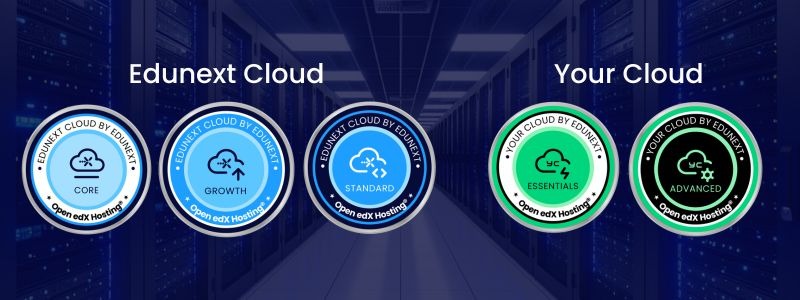
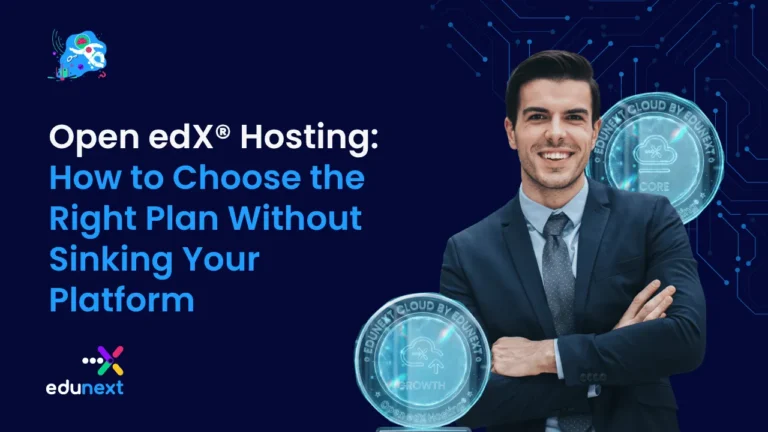
Open edX® Hosting Plans: The edunext Fleet
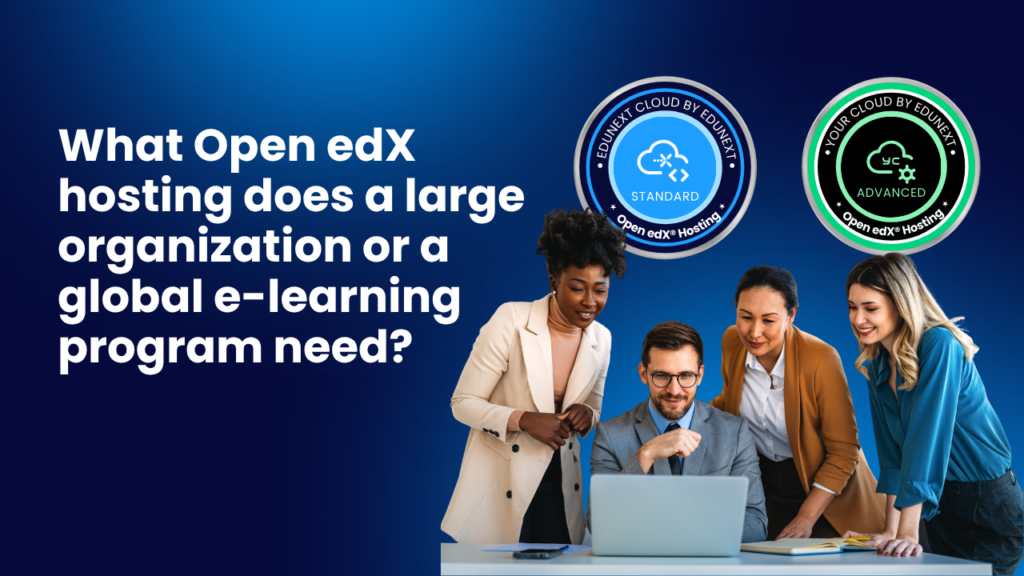
At edunext, we redesigned our hosting portfolio to better reflect the real diversity of institutions running Open edX®. The result is two product lines with more accessible entry points and clearer options depending on each organization’s context.
Edunext Cloud (EC): Fully Managed Open edX® Hosting
For organizations that want to run on infrastructure managed by edunext on AWS, with optimized resources and support included.
EC Core is the entry point. Designed for programs that are starting out or operating at a smaller scale, supporting up to 1,500 monthly active users. It includes an updated Open edX® release, high-availability Kubernetes architecture, daily backups, and technical support. Starting at USD 8,000 per year.
EC Growth adds Aspects for advanced analytics, higher compute capacity (up to 2,500 MAU), an optional permanent staging environment, and 99.5% uptime SLA. Starting at USD 12,500 per year.
EC Standard is the robust production option for established programs. It supports up to 200 concurrent users (roughly 3,000 MAU), includes full vulnerability management, authorized pen testing, data protection compliance, and up to 40 technical support tickets per year. Starting at USD 19,000 per year.
Your Cloud (YC): Open edX® Hosting on Your Infrastructure
For organizations that need to run Open edX® on their own cloud (AWS, GCP, or Azure) and want edunext to manage the operation on top of that infrastructure.
YC Essential provides a dedicated deployment with Kubernetes architecture, CI/CD pipeline, monitoring, and support. The customer provides the infrastructure; edunext handles the rest. Starting at USD 18,000 per year.
YC Advanced adds Aspects, a permanent staging environment, 99.9% guaranteed uptime, an Incident Response Team, and deeper support coverage. Built for operations that require enterprise-level reliability and responsiveness. Starting at USD 26,300 per year.
Both lines include yearly Open edX® version upgrades, critical patches applied within 24 hours, and full access to the ecosystem of extensions and integrations.

Open edX® Hosting Pricing: What You Should Know
One of the most common questions when evaluating Open edX® hosting is about cost. The answer depends on your scale, your infrastructure model, and the level of support you need.
As a reference, edunext’s managed hosting plans start at USD 8,000 per year for the EC Core plan, which supports up to 1,500 monthly active users. At that scale, the cost per active user per month is well under $1, which compares favorably with most proprietary LMS platforms at an equivalent scale.
For larger deployments, the Your Cloud model can be significantly more cost-efficient. With the YC Advanced plan optimized for scale, the cost per monthly active user can drop to under USD 0.50, making it one of the most competitive options available for open source LMS platforms at enterprise scale.
Which Plan Is Right for You?
There is no universal answer.
The right Open edX® hosting plan depends on the size of your operation, your infrastructure governance model, your growth trajectory, and the level of support your team requires. An institution serving a few hundred learners has very different needs from one supporting thousands of active users across multiple programs, regions, or business units.
What is universal, however, is the importance of having a hosting strategy that supports your long-term goals rather than simply meeting today’s requirements. As the Open edX® ecosystem continues to evolve—with AI-powered learning experiences, advanced analytics, verifiable credentials, and richer integrations becoming increasingly important—the ability to adopt new capabilities quickly will become a competitive advantage.
Hosting is no longer just an infrastructure decision. It directly affects your platform’s security, performance, scalability, and ability to take advantage of innovations across the Open edX® ecosystem.
The institutions that benefit most from Open edX® are not necessarily those with the largest budgets. They are the ones that build on a foundation that allows them to move confidently as their needs evolve.
If you’re evaluating Open edX® hosting options or considering a change to your current setup, we’d be happy to help you assess your requirements and identify the model that best fits your goals.
Talk to our team to explore the right hosting strategy for your organization.