An open-source, AI-ready learning platform built for scale, flexibility, and long-term value
Selecting a learning management system for 2026 is no longer just about comparing feature lists. It is about choosing a platform that can evolve with technology, pedagogy, and organizational strategy—without creating long-term dependency or limiting innovation. Institutions planning for the coming years are asking critical questions: Who controls the platform? How adaptable is it? Can it scale sustainably? And how prepared is it for AI-driven learning?
In this context, Open edX® clearly stands out as one of the strongest LMS options for 2026. As an open-source platform maintained by a global community and already laying the groundwork for responsible AI adoption, Open edX® offers a level of flexibility, transparency, and future-readiness that proprietary systems struggle to achieve.

2026: A Defining Moment for LMS Strategy
By 2026, learning platforms must support far more than content delivery. Organizations across higher education, corporate learning, government, and social impact initiatives need systems that enable skills-based education, lifelong learning pathways, accessibility compliance, advanced analytics, and seamless integration with external tools. At the same time, many institutions are reassessing the long-term risks of closed platforms, including vendor lock-in, limited customization, and dependence on proprietary roadmaps.
Open edX® addresses these challenges at a foundational level. Rather than layering innovation on top of a closed core, it provides an open, extensible architecture that organizations can shape to meet their own needs—today and in the future.

Open Source as a Strategic Advantage for 2026 and Beyond
One of the most essential reasons Open edX® is well-positioned for 2026 is that it is open source by design. This is not simply a licensing detail; it is a strategic advantage. Open source gives organizations control over their learning platform, their data, and their ability to innovate without being constrained by a single vendor’s priorities or timelines.
Open edX® is maintained by a diverse and highly committed global community that includes universities, companies, governments, nonprofits, and technology partners. This community actively contributes code, shares best practices, and guides the platform’s evolution. As a result, Open edX® grows in response to real educational and workforce needs, not just commercial objectives.
For organizations planning long-term learning strategies, open source represents sustainability, transparency, and freedom of choice.
Proven Global Impact: What the 2024 Open edX® Impact Report Shows
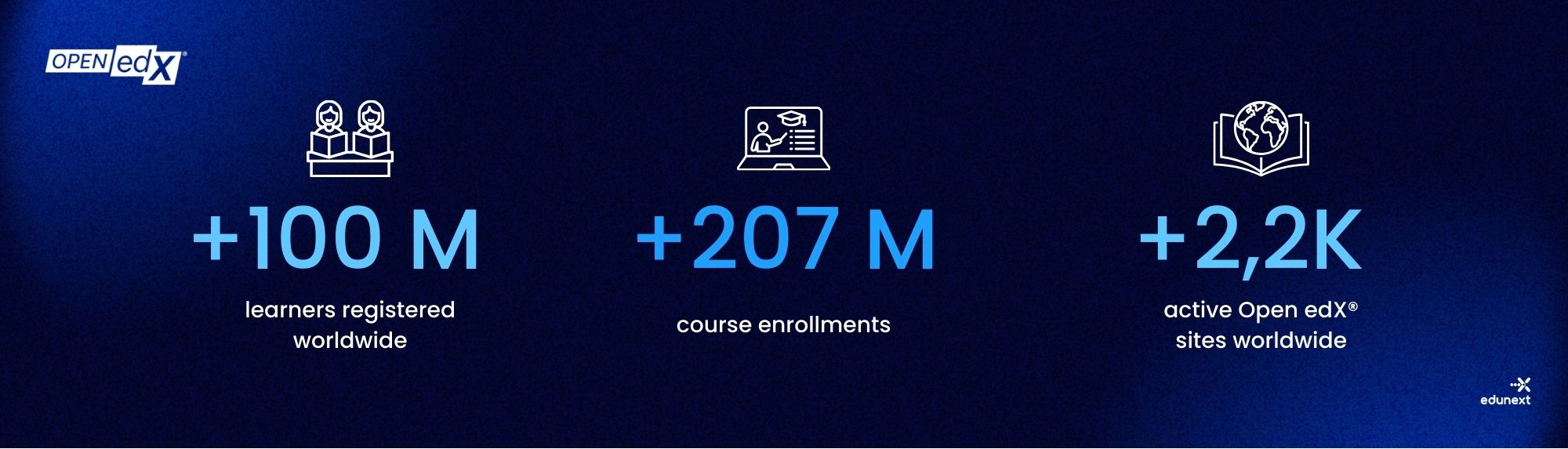
The strength of Open edX® is not theoretical—it is measurable and global. According to the 2024 Open edX® Impact Report, the platform has now reached a historic milestone, surpassing 100 million learners registered worldwide. As of 2024, Open edX® accounts for 100,526,576 total learner registrations and more than 207 million course enrollments, reflecting sustained growth across diverse learning contexts and geographies.
This impact is supported by a rapidly expanding ecosystem. The report identifies 2,293 active Open edX® sites worldwide, representing an 18% year-over-year increase in platform adoption. These instances span higher education, government initiatives, workforce development programs, nonprofits, online academies, and corporate learning environments, confirming Open edX®’s versatility across sectors.
The scale of adoption is matched by global reach. Open edX® powers learning initiatives across dozens of countries, with strong representation in North America, Western Europe, South Asia, Africa, Latin America, and the Middle East. This geographic distribution highlights the platform’s ability to support both highly scaled national programs and localized institutional deployments under very different regulatory, linguistic, and infrastructural conditions.
Equally important is the health of the open-source ecosystem behind the platform. During 2024 alone, the Open edX® project saw contributions from 1,334 unique contributors, including 335 active code authors, supported by 15 organizations actively participating in platform development. The community also produced approximately 16 million lines of code added or removed, underscoring the pace of innovation, modernization, and long-term maintenance required to sustain a platform of this scale.
Together, these figures demonstrate that Open edX® is not an experimental or emerging LMS. It is a mature, globally adopted, open-source learning platform already operating at a scale that most organizations aspire to reach. For institutions planning their LMS strategy for 2026 and beyond, the data from the 2024 Impact Report provides clear evidence that Open edX® delivers both reach and resilience at a global level.
Interoperability and Ecosystem-first Design
Learning in 2026 does not happen inside a single system. Modern LMS platforms must integrate seamlessly with student information systems, HR platforms, credentialing services, analytics tools, and emerging AI solutions. Open edX® embraces this reality through its strong commitment to open standards and interoperability, including support for frameworks such as LTI Advantage.
By acting as a central learning hub rather than a closed environment, Open edX® allows organizations to build flexible ecosystems around their LMS. This approach reduces technical friction, simplifies future integrations, and protects institutions from technological dead ends as tools and requirements evolve.
Skills, Credentials, and Outcome-driven Learning
The shift toward skills-based and outcome-driven learning is one of the defining trends shaping LMS requirements for 2026. Learners and employers increasingly expect education to translate into verifiable competencies and real-world impact. Open edX® supports this shift by enabling modular learning design, stackable programs, and digital credentials that reflect meaningful achievements.
These capabilities make Open edX® particularly effective for professional certificates, executive education, workforce development initiatives, and public-sector training programs. Organizations can design learning pathways aligned with skills frameworks, job roles, and societal needs—supporting lifelong learning at scale.

AI Readiness Through the Open edX® AI Framework Project
Artificial intelligence is rapidly transforming expectations around personalization, learner support, assessment, and content creation. Instead of embedding opaque, vendor-controlled AI features into the platform, the Open edX® community has taken an open and responsible approach through the AI Framework Project.
This framework provides a structured way to extend Open edX® with AI-powered capabilities while maintaining transparency, flexibility, and institutional control. Organizations can experiment with AI tutors, content assistance, or analytics tools, choose the models that align with their values and regulations, and adapt as AI technologies evolve.
By participating in the AI Framework Project, edunext supports an open, modular, and community-driven approach to AI. This ensures that AI innovation in Open edX® strengthens—not compromises—the platform’s core values of openness, adaptability, and long-term sustainability.
For organizations planning their LMS strategy for 2026, this AI-ready foundation means Open edX® is prepared for the next wave of educational innovation—without forcing institutions into proprietary AI solutions or one-size-fits-all implementations.
Scalable by Design, Sustainable by Choice
Selecting an LMS for 2026 means future-proofing your learning investment. Organizations choose platforms that evolve with new learning models, integrate effortlessly with emerging technologies, and scale sustainably as needs grow. Open edX® delivers lasting value, strategic flexibility, and relevance well beyond 2026.
Its proven scalability, highlighted in the 2024 Impact Report, combined with open governance and community-driven innovation, allows organizations to grow confidently without replatforming or sacrificing control.
A platform shaped by a global community, not a single vendor
One of the most powerful differentiators of Open edX® is its global community. Universities, companies, governments, and nonprofits around the world actively shape the platform, ensuring it reflects diverse perspectives and real-world requirements. Regularly named releases, transparent roadmaps, and shared best practices make Open edX® a continuously evolving platform rather than a static product.
Partners like edunext help organizations translate this open technology into stable, secure, and scalable learning platforms—while preserving the freedom, flexibility, and transparency that open source provides.

Why Open edX® makes sense beyond 2026
Choosing an LMS today is a long-term strategic decision. Organizations need platforms that remain adaptable, innovative, and sustainable as education, technology, and workforce needs continue to evolve. Open edX® combines open-source governance, proven global impact, AI readiness, and community-driven development into a single platform designed for long-term relevance.
For organizations planning their learning strategy for 2026 and beyond, Open edX® is not just a viable LMS option—it is a strategic choice aligned with the future of digital learning.
If your organization is evaluating LMS options for 2026, Open edX® offers a proven, future-ready foundation—and edunext helps you turn that foundation into a successful learning platform. With deep experience implementing, customizing, and supporting Open edX® at scale, edunext partners with universities, companies, and public institutions to design platforms that align with real learning goals. Whether you are launching a new initiative or modernizing an existing one, edunext helps you move from evaluation to impact with confidence.
Contact our team at sales@edunext.co to discuss your LMS strategy for 2026 and beyond.