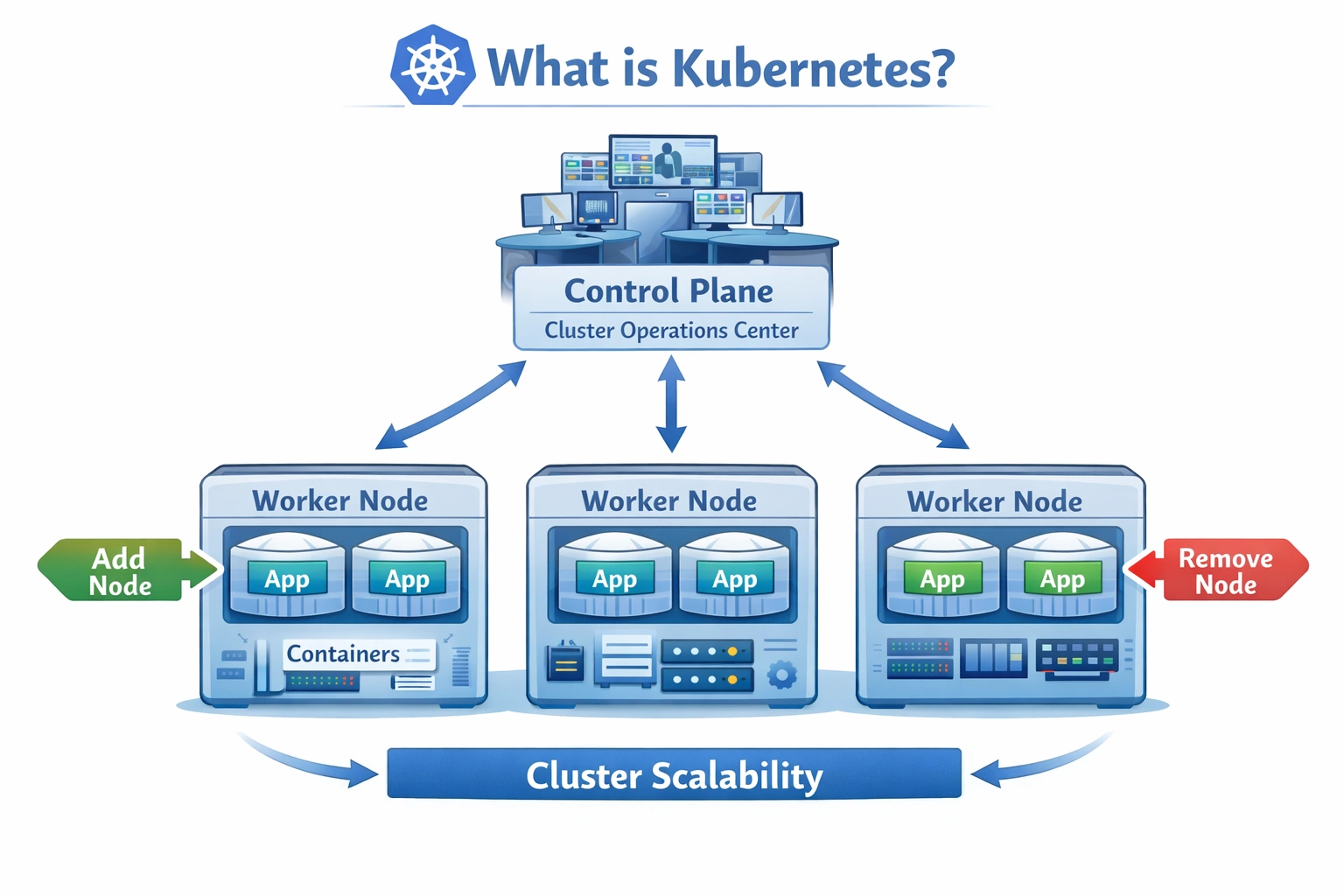
What is Kubernetes?
Choosing between AWS and Azure for Open edX® hosting is one of the most important infrastructure decisions an organization will make. Both cloud providers are fully capable of supporting production-grade Open edX® deployments, but they differ in ecosystem maturity, governance alignment, operational familiarity, and long-term scalability implications. For institutions evaluating their options, the key question is not which cloud is more powerful—but which model reduces risk and ensures sustainable platform operations over time.
Choosing a cloud provider is one of the first major decisions organizations face when adopting Open edX®. For some institutions, that choice is already made. For many others, it is still an open question.
This article is written for organizations that are still evaluating cloud platforms and deciding between AWS and Azure—typically governments, universities, NGOs, and enterprises where the priority is not cloud experimentation but platform success, risk reduction, and long-term sustainability.
Why does infrastructure matter so much for learning platforms?
Educational platforms experience usage patterns that differ dramatically from traditional enterprise software. When a university opens enrollment for a popular course, thousands of students may access the platform simultaneously. National training programs and MOOCs generate sudden traffic spikes when new modules are released.
Without elastic infrastructure, these events overwhelm servers and degrade the learning experience precisely when it matters most. Kubernetes addresses this by enabling dynamic infrastructure that adapts to demand in real time — scaling resources up during peak periods and releasing them when demand drops, optimizing both performance and cost.
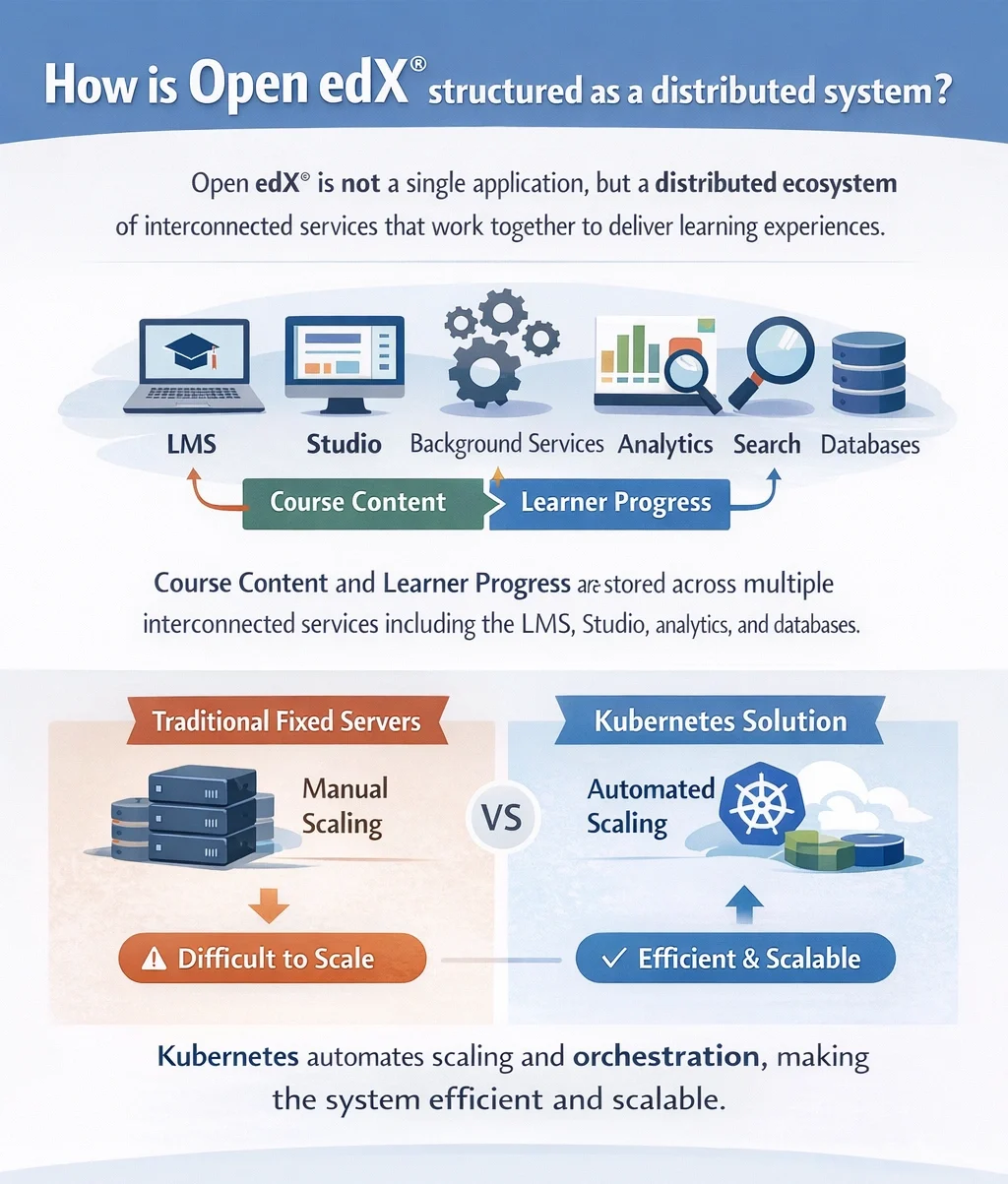
How is Open edX® structured as a distributed system?
Open edX® is not a single application. It is a distributed ecosystem of interconnected services that work together to deliver learning experiences — including the LMS, the Studio authoring environment, background processing services, analytics tools, search systems, and multiple databases storing course content and learner progress.
When a learner opens a course page, submits an assignment, or watches a video, several of these services interact simultaneously. In traditional fixed-server deployments, scaling this architecture requires manually provisioning servers and managing complex dependencies — which becomes unsustainable as learner numbers grow. This is where Kubernetes introduces a significant architectural improvement.

How does Kubernetes support Open edX® deployments?
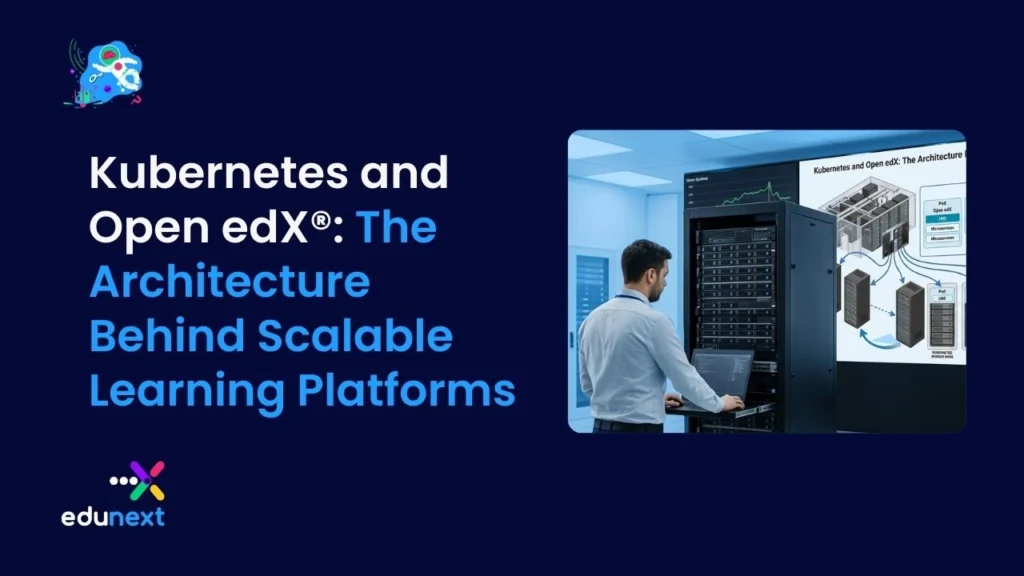
Modern Open edX® deployments use the Tutor distribution, which packages the platform into containerized services. Kubernetes orchestrates these containers — determining where they run, how many instances are active, and how they communicate.
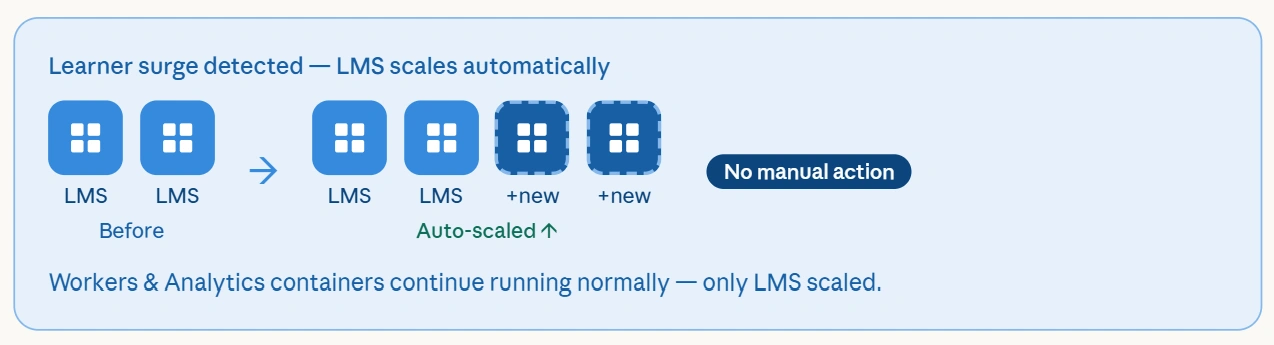
This allows individual services to scale independently. If a surge of learners accesses course pages, Kubernetes launches additional LMS containers automatically — without touching the analytics or worker services running normally. If background tasks like grading require more resources, additional worker containers are created on demand.
The system continuously monitors the health of each component. If a container stops responding or a server becomes unavailable, Kubernetes replaces it automatically without disrupting the platform — making Open edX® capable of operating as a highly resilient, distributed learning system at global scale.
Kubernetes vs. traditional infrastructure — what changes in practice?
For organizations evaluating their options, the differences are significant across every operational dimension:
Traditional infrastructure | Kubernetes-based infrastructure | |
Scaling | Manual — requires provisioning new servers | Automatic — responds to real-time demand |
Failure recovery | Manual intervention required | Self-healing — automatic replacement |
Deployments | Risk of downtime during updates | Rolling updates with zero downtime |
Resource efficiency | Over-provisioned for peak load | Dynamic allocation — pay for what you use |
Multi-environment | Complex and error-prone | Namespaced isolation per environment |
Operational overhead | High — requires a dedicated infrastructure team | Low — automation handles routine tasks |
The operational overhead difference is particularly meaningful for organizations without large DevOps teams. Kubernetes automates the majority of infrastructure work — allowing smaller teams to operate platforms that would otherwise require significantly more personnel.

Kubernetes as the Foundation of Scalable Digital Learning
As online education continues to expand, infrastructure is becoming a strategic component of digital learning initiatives.
Platforms must support millions of learners, integrate with evolving technologies, and adapt quickly to new educational models.
Kubernetes provides the architectural foundation that makes this possible.
By combining the flexibility of Open edX® with Kubernetes-based infrastructure, organizations gain a learning platform that scales globally, operates reliably, and evolves continuously to meet the needs of modern education.
But designing and operating this architecture requires deep expertise in both the platform and the cloud ecosystem.
At Edunext, we help universities, governments, and organizations launch and operate Open edX® platforms using Kubernetes-based infrastructure designed for growth. Our team manages the infrastructure so you can focus on learning experiences, content, and impact.
Discover how Edunext Hosting can support your Open edX® platform.
What are the strategic benefits for EdTech organizations?
For universities, governments, and corporations investing in digital learning, Kubernetes-based infrastructure delivers several long-term advantages.
Platforms can scale from small pilot programs to global learning initiatives without architectural redesign. Infrastructure grows alongside demand, allowing institutions to expand with confidence. System resilience improves dramatically — automated recovery mechanisms reduce downtime and maintain learner access even when components fail.
Kubernetes also enables faster innovation cycles, allowing development teams to deploy updates and integrations more frequently without disrupting the learning environment. Critically, Kubernetes is cloud-native by design — Open edX® environments can run on AWS, Google Cloud, Azure, or private cloud, meaning organizations are not locked into a single provider and can migrate if their strategy changes.
Frequently Asked Questions
Does Open edX® require Kubernetes to operate?
No. Open edX® can run on traditional server-based infrastructure. However, Kubernetes significantly improves scalability, resilience, and operational efficiency — making it the recommended approach for platforms serving thousands of learners or experiencing variable traffic.
What is the Tutor Open edX® distribution?
Tutor is the official Open edX® distribution that packages the platform into containerized services. It is the most widely used deployment method in the community and the foundation for Kubernetes-based Open edX® installations.
What is the Harmony initiative and what role does edunext play?
Harmony is an Open edX® community project that provides standardized guidelines and tooling for running Open edX® on Kubernetes at large scale. edunext is an active contributor, helping develop and maintain shared infrastructure that benefits the entire Open edX® community.
Can Kubernetes-based Open edX® run on any cloud provider?
Yes. Kubernetes runs on AWS, Google Cloud, Azure, DigitalOcean, and private cloud environments. Organizations are not tied to a single provider and can migrate their Open edX® platform if their strategy or requirements change.
How does edunext manage Kubernetes infrastructure for its clients?
Edunext operates the full infrastructure layer — cluster management, autoscaling, database administration, monitoring, and CI/CD pipelines. Clients manage their platform through the edunext Control Center without needing infrastructure expertise. Learn more at edunext.co/hosting.
Key Takeaway
Kubernetes provides the architectural foundation that allows Open edX® platforms to scale globally, operate reliably, and evolve continuously. The evidence is not theoretical — edunext has deployed this infrastructure for universities like BUAP, national government initiatives like NAU, and global organizations like Pearson. For organizations planning digital learning initiatives beyond 2026, the question is not whether Kubernetes is the right infrastructure choice — it’s whether your current provider has the expertise to operate it at the scale your programs require.